I Know the Basics, But I Still Don’t Feel Job-Ready — Why
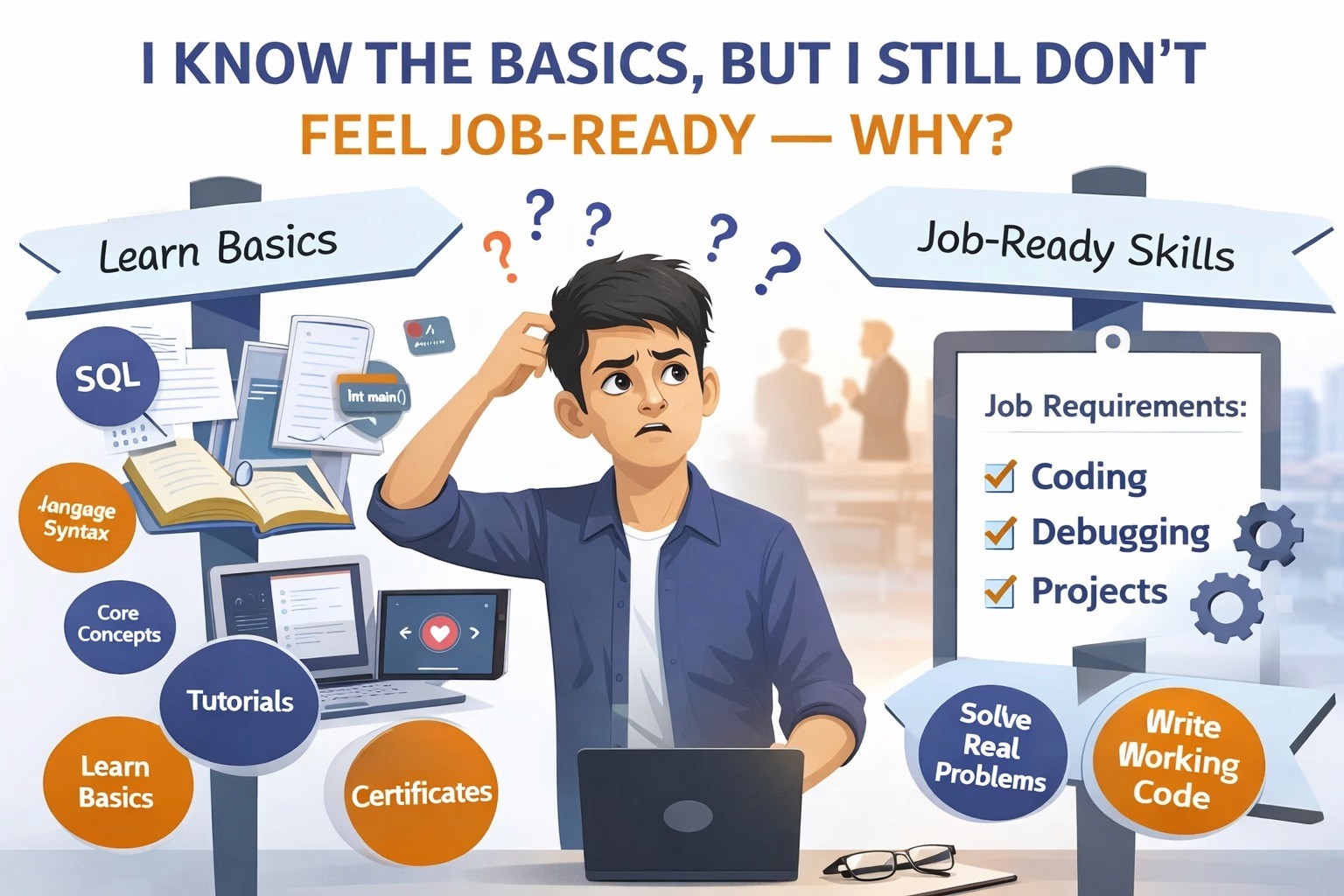
This is one of the most common thoughts among IT freshers in India. You’ve learned a programming language, completed courses, maybe even solved some coding problems—yet when you look at job descriptions or think about interviews, you still don’t feel confident.
This feeling is normal. More importantly, it has clear reasons—and clear solutions.
1. Knowing basics is not the same as applying them
Most freshers “know” basics in theory:
Syntax of a language
Definitions of concepts
Steps from tutorials
But interviews and jobs test application, not recall. Companies expect you to:
Use basics to solve new problems
Debug when things break
Combine multiple concepts together
If you’ve mostly watched videos or followed step-by-step demos, your basics may exist—but they are not yet usable under pressure.
2. You haven’t practiced in real hiring conditions
Real hiring involves:
Timed skill tests
Incomplete or tricky problem statements
Follow-up questions in interviews
Many freshers practice without time limits, pause videos, or look up answers. That builds familiarity, not readiness. Job readiness comes when you can think, code, or explain without external help, even if you make small mistakes.

3. Lack of project ownership creates insecurity
A very common reason for low confidence is projects you didn’t fully own.
Ask yourself honestly:
Did I design the logic myself?
Can I explain the data flow end-to-end?
One should be able to answer if interviewers ask “Why did you choose this approach?”
If projects were mostly guided or copied, your brain knows this—and that’s why confidence drops during interviews.
4. Basics are scattered, not connected
Freshers often learn topics in isolation:
One day Java basics
Another day SQL
Another day APIs
But jobs require connecting the dots:
How does data move from UI → backend → database?
Where does validation happen?
What breaks if one part fails?
Until you see the full picture, you’ll feel like something is missing—even if each individual topic feels familiar.
5. You haven’t practiced explaining your thinking
Job readiness is not just about doing the work—it’s about explaining it clearly.
Many freshers:
Can solve a problem silently
But struggle to explain logic aloud
Panic when asked “why” or “what if”
Interviews test communication because teams work through discussion. If you haven’t practiced explaining, confidence naturally drops.
6. Job descriptions make the gap feel bigger than it is
Job descriptions often list many skills together:
Language + framework + database + cloud + tools
Freshers read this and assume they must know everything. In reality, companies expect basic readiness and learning ability, not mastery of all tools. The gap feels bigger on paper than it actually is.
7. You are comparing yourself to the wrong benchmark
Social media, LinkedIn posts, and peer comparisons distort reality. You mostly see:
Success stories
High-skill demos
“Cracked X company” posts
You don’t see the months of confusion and practice behind them. Comparing yourself at an early stage to someone further along creates unnecessary self-doubt.
Moving from basic understanding to job confidence
• Convert theory into repetition
Practice the same type of problems multiple times until patterns feel natural.
• Build one solid, explainable project
Depth in one project beats surface-level knowledge of many.
• Practice under time pressure
Mock tests and timed coding sessions change how your brain responds.
• Practice explanation daily
Explain your code, project, or concept out loud—even to yourself.
• Apply while preparing
Interviews themselves improve readiness. Waiting for “complete confidence” delays growth.
Final takeaway
Feeling “not job-ready” despite knowing basics does not mean you are incapable. It means you are in the transition phase between learning and applying—a phase every successful IT professional has gone through.
Job readiness is built through practice, ownership, explanation, and exposure, not overnight confidence. With structured guidance, real projects, and interview-focused preparation—like the approach followed by VibrantMinds Technologies Pvt Ltd—freshers can bridge this gap steadily and realistically.
You are closer than you think. Keep going.
Join WhatsApp Groups for Updates
Group 1: CLICK HERE> https://chat.whatsapp.com/KAXuSLpag96DcdMDsphFrO
📢 Don’t forget to forward this message to your friends and help them kick-start their careers