What Freshers Should Do When They Don’t Meet Job Requirements
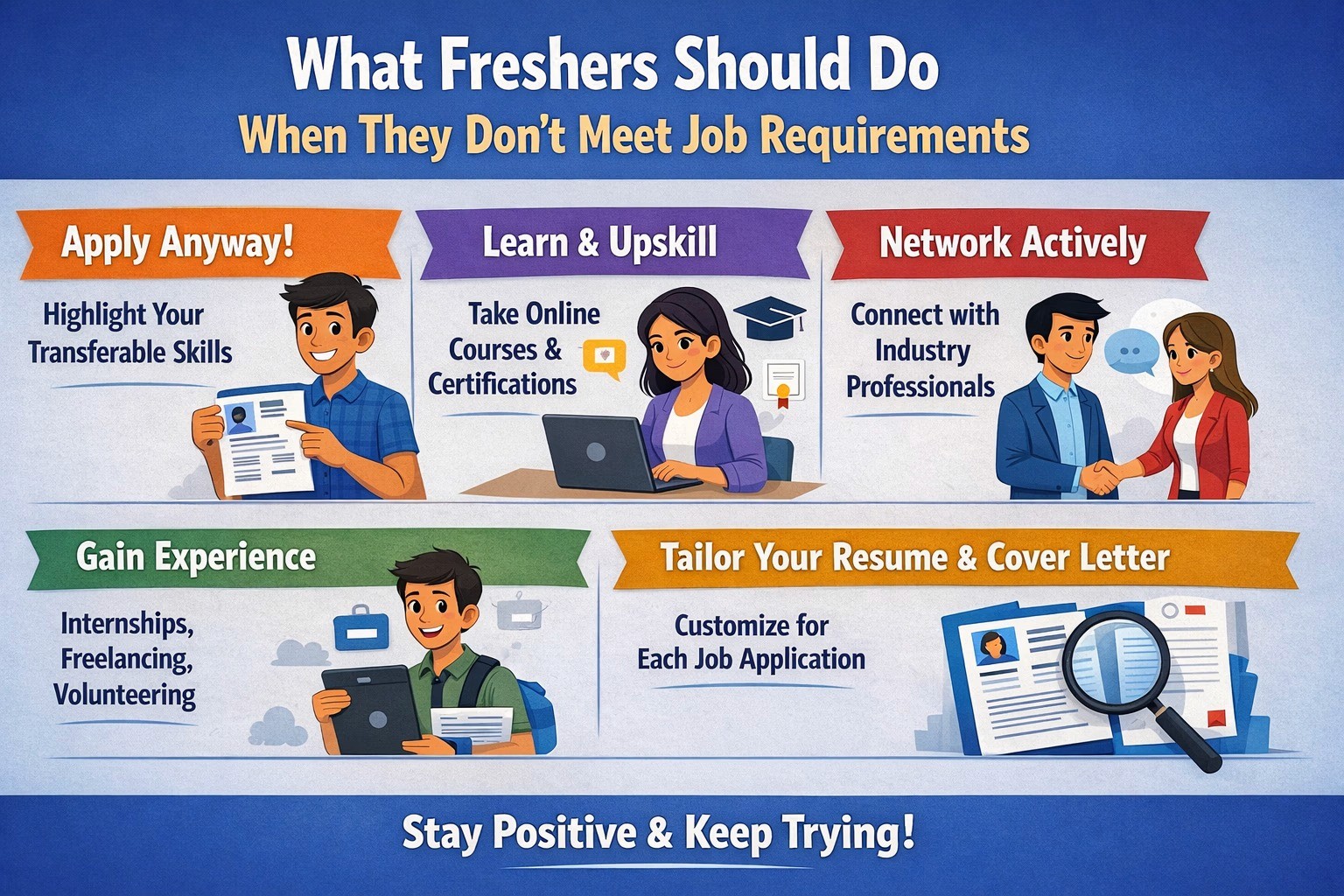
Don’t match every job requirement as a fresher? Learn what to do—how to read job descriptions, identify must-have skills, build proof fast, and apply smartly in the Indian IT job market.
Introduction
Most freshers in India face the same stress: you open a job post and it feels like the company wants someone who already has experience, tools, and “industry exposure.” But here’s the real point: job descriptions often describe an ideal candidate. Hiring teams still shortlist people who can learn, show proof, and meet the key needs of the role. Skills-based hiring is also becoming more common, with employers increasingly focusing on skills and potential, not only credentials.
Step 1: Read job requirements the right way
Many freshers treat job requirements like a strict eligibility checklist. In practice, many job descriptions include “nice-to-have” items along with essentials.
So don’t ask, “Do I match everything?” rather practice on must haves.

Must-have clues:
repeated skills (mentioned multiple times)
core language/stack (Java/Python + SQL, etc.)
basic concepts (OOP, DB, APIs)
role expectations (support, testing, development)
Step 2: Match the role to your current strengths
Make a simple 2-column list:
A) What the job needs
B) What proof I already have
Proof can be:
a project feature you built
a GitHub repo
a mini-assignment you completed
a certification (only if backed by hands-on work)
This step reduces panic because you’ll see you’re not “zero.” You’re just incomplete.
Step 3: Fill gaps with “proof-building,” not just learning
Freshers often respond by watching more videos. That helps knowledge, but hiring needs proof.
Instead, build small, visible proof in 7–14 days:
If JD asks SQL → build 10 real queries on a sample dataset + save screenshots/notes
If JD asks APIs → create a simple CRUD API or consume a public API and display results
If JD asks Git → show commits, branches, and README steps
If JD asks debugging → document one bug you fixed and how you found it
This converts “I’m learning” into “I can do.”
Step 4: Apply anyway—but apply smartly
When you don’t match everything, your best chance is to make your application easy to trust.
Do this in your resume:
Put the role’s core skills in your top section (only what you truly know)
Add one “Proof Project” with 3 bullets: what you built, your role, what you fixed/improved
Keep it simple and clean
Do this in your email/message (if you send one):
one line on your fit
one line on proof (project link)
one line on learning ability (how you handle new tools)
Why this matters: employers consistently rate skills like communication, teamwork, and critical thinking/problem-solving very highly—especially for early career hiring.
Step 5: Answer the “requirements gap” question confidently in interviews
Do not freeze because the interviewer says, “You haven’t used X,”
Use a safe structure: (Acknowledge) “I haven’t used it in a job yet ____ ” (Relate) “But I’ve used similar concepts in ____”, (Strategies)“I would begin by understanding the problem and then ____.” (Result) “I developed this understanding while working on my project.”
This shows learning ability, not excuses.
Conclusion
Not meeting every job requirement is normal for freshers. What matters is your response: identifying must-have skills, building practical proof quickly, and communicating clearly.
With skills-based hiring on the rise, freshers who demonstrate real work and learning potential often succeed—even when they don’t match every line in a job description. With the right guidance and structured preparation, like that provided at VibrantMinds Technologies Pvt Ltd, these gaps become stepping stones, not barriers.
Join WhatsApp Groups for Updates
Group 1: CLICK HERE> https://chat.whatsapp.com/KAXuSLpag96DcdMDsphFrO
📢 Don’t forget to forward this message to your friends and help them kick-start their careers